


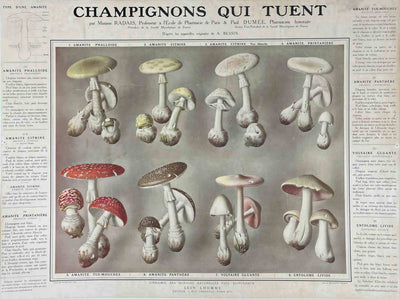
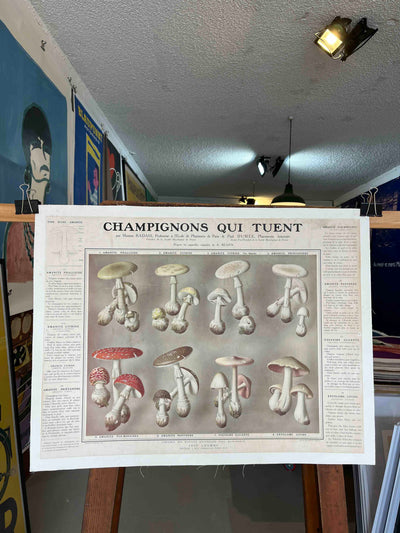
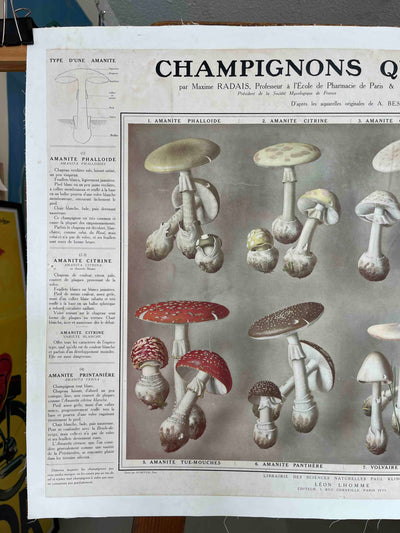
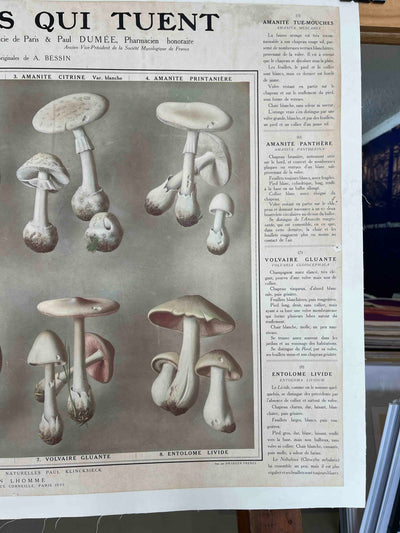
This French scientific wall chart titled 'Champignons qui tuent' ('Mushrooms that kill') was created as a public-education tool to help people recognise dangerous poisonous mushrooms. It was produced in the early 20th century, with the scientific content written by the French mycologist Maxime Radais, professor at the École de Pharmacie de Paris, together with Paul Dumée, a pharmacist and member of the French mycological society. The detailed illustrations are based on artwork by A. Bessin.
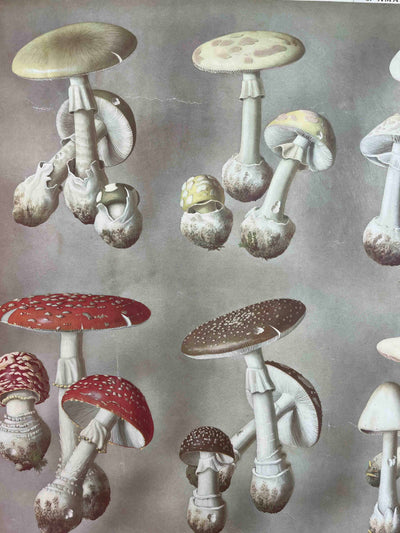
The chart carefully depicts several highly toxic species – including Amanita phalloides (death cap), Amanita muscaria (fly agaric), Amanita pantherina, and Entoloma lividum – showing different stages of growth along with explanatory text describing their identifying features. Published by the Paris scientific publisher Librairie des Sciences Naturelles – Paul Klincksieck, the chart was intended for schools, pharmacies, botanical societies and rural institutions where mushroom poisoning was a real concern. Like many educational charts of the period, it combines precise natural-history illustration with clear scientific labelling to help viewers identify hazardous species and avoid accidental poisoning.
Year: 1920s
Dimensions: 50cm x 68cm
Materials/Media: Original lithograph, linen backed